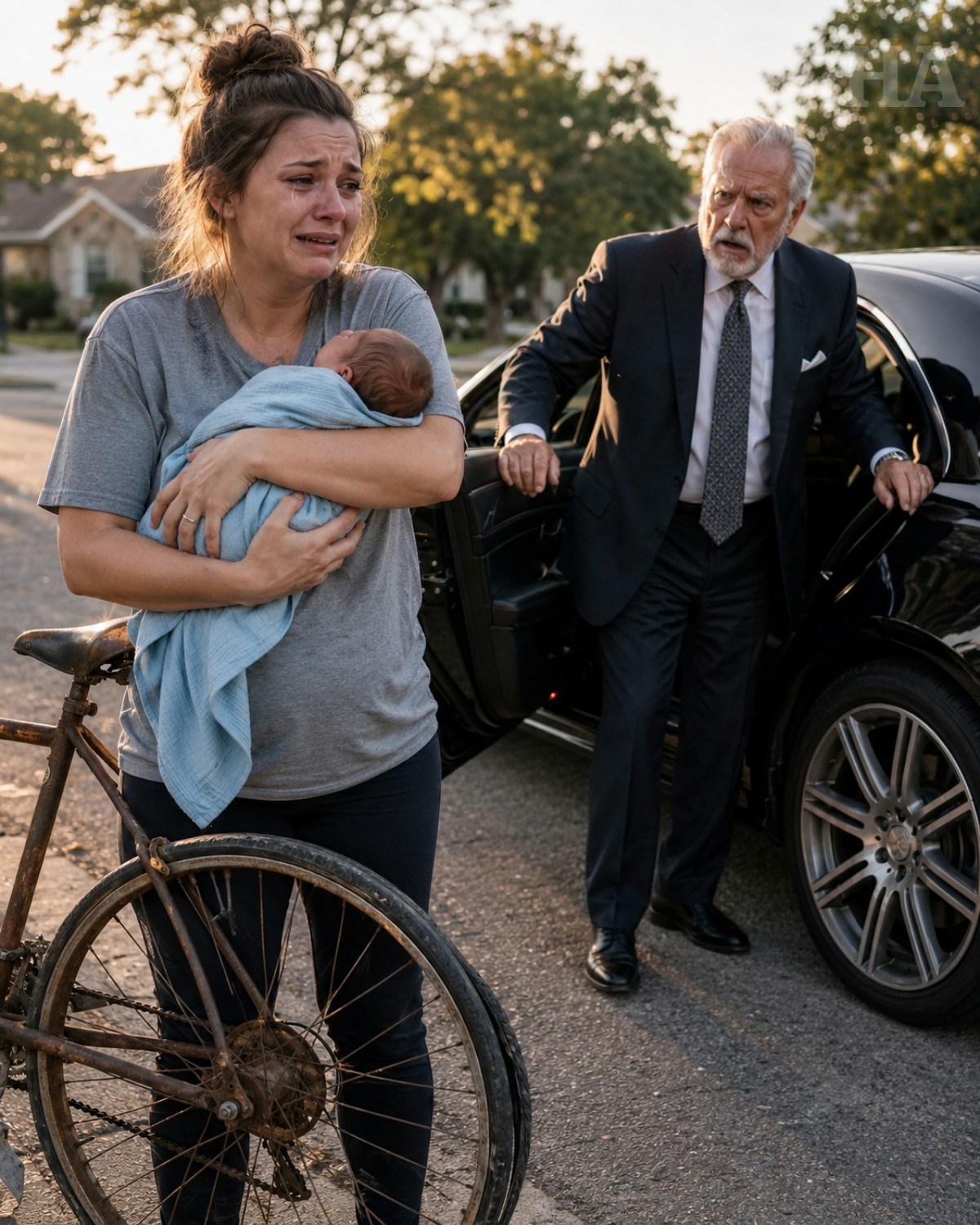
Roberto was “peaceful.”
“Patient.”
“Easygoing.”
But maybe peace that demanded your silence was not peace at all.
Maybe it was cowardice with clean shoes.
Your grandfather turned into a quiet street and parked under the shade of an old jacaranda tree. Purple petals had fallen across the sidewalk like torn paper.
He turned around fully.
“Valeria, listen to me carefully. Did they ever hurt you physically?”
You hesitated.
That hesitation answered too much.
His eyes darkened.
“Valeria.”
“My mother grabbed my arm once. Hard. I still had stitches from the birth. I was trying to leave the house because Santiago had a fever and she said I was being dramatic.”
You shifted the baby carefully and pulled your sleeve up.
The bruise had faded yellow, but it was still there.
Your grandfather looked at it.
Then closed his eyes.
For a moment, he looked older than you had ever seen him.
“What else?”
You did not want to say it.
But the words came.
“They don’t always let me eat enough.”
His eyes opened.
“What?”
“Mamá says I need to lose the baby weight. She says Miguel won’t want me if I look ruined. But I’m breastfeeding sometimes, and I get dizzy. She locks the pantry at night.”
The silence that followed was so heavy you could hear Santiago’s soft breathing.
Your grandfather turned back toward the wheel.
“Do you have your documents?”
“My ID is in my room. Santiago’s birth certificate too. Miguel’s letters. Our marriage certificate. But Mamá keeps the folder in her closet.”
He nodded once.
“Good.”
“Good?”
“It means I know where to go.”
Your stomach tightened.
“Grandfather, please don’t make it worse.”
He looked at you in the mirror again.
“My child, it is already worse. You have only been trained to call it normal.”
You looked down.
That sentence hurt.
Because it was true.
He drove first to a private clinic.
Not the big hospital where your mother could call a cousin and perform concern in front of nurses.
A small, discreet clinic owned by a former military doctor who seemed to know your grandfather well.
Dr. Ibarra examined you gently, then Santiago.
You were dehydrated.
Anemic.
Exhausted.
Your blood pressure was unstable.
Santiago had mild weight concerns but was otherwise safe.
Safe.
You clung to that word.
The doctor took photos of the bruise on your arm.
He documented your condition.
He asked questions about food, sleep, medication, postpartum symptoms, and whether anyone at home was preventing communication with your spouse.
You answered softly, but you answered.
Your grandfather stood near the window the whole time, hands clasped behind his back, saying nothing.
When the doctor finished, he handed Ernesto a folder.
“Medically, she needs rest, nutrition, and a safe environment. Legally, she needs protection.”
Your grandfather nodded.
“That’s why I called you.”
Your heart jumped.
“You called him before?”
He looked at you.
“When I saw you pushing a broken bike with a newborn in your arms, I knew the car was only the door. I needed to know what was behind it.”
The next stop was not your parents’ house.
It was a law office.
A woman named Mariana Cortés met you after hours. She was in her fifties, with silver glasses, sharp eyes, and the kind of calm that made panicked people breathe slower.
Your grandfather placed the medical report on her desk.
“This is my granddaughter, Valeria. Her husband is stationed at the naval base in Veracruz. Her parents have isolated her, controlled her finances, taken her vehicle, interfered with spousal communication, and neglected her postpartum care. Her sister is driving a vehicle I gifted to Valeria and has likely used funds meant for the baby.”
Mariana looked at you.
“Is that accurate?”
You opened your mouth to soften it.
To say, “It’s complicated.”
To say, “They probably meant well.”
To say, “Maybe I’m just tired.”
Then Santiago stirred in your arms, and you remembered the empty formula container on the kitchen shelf.
“Yes,” you said.
Mariana nodded.
“Good. First truth is usually the hardest.”
Your grandfather leaned forward.
“I want her and the baby out tonight. I want her documents recovered. I want the car returned. I want the bank accounts frozen if there is misuse. And I want her husband notified directly, not through her mother.”
Your stomach twisted.
“Miguel.”
Mariana softened slightly.
“Does your husband know any of this?”
You shook your head.
“He thinks I’m resting. That my mom is helping.”
“Do you want him notified?”
Tears filled your eyes.
“Yes. But I’m scared.”
“Of him?”
“No.” You swallowed. “Of what my mother told him. Of what she made him believe.”
Your grandfather leaned toward you.
“What did she make him believe?”
You wiped your face with the heel of your hand.
“That I’m unstable. That I might hurt myself if pressured. That I don’t want visitors. She told me if I complained, Miguel could lose focus at work and something bad could happen. She said a good wife doesn’t distract a man in service.”
Your grandfather’s expression turned into something carved from stone.
“Mariana,” he said, “call the commander.”
You stared.
“The commander?”
Your grandfather did not look at you.
“I served with his father.”
Of course he did.
Ernesto Salazar had a way of knowing doors existed before anyone else saw a wall.
Within thirty minutes, a secure call was placed to the naval base.
Your husband appeared on Mariana’s laptop screen in uniform, confused and pale.
“Valeria?”
The moment you saw his face, you broke.
Not elegantly.
Not quietly.
You began sobbing so hard Santiago startled awake and cried too.
Miguel’s face changed instantly.
“What happened? Valeria, where are you? Where is my son?”
Your grandfather stepped into frame.
“Miguel. She and Santiago are safe. But your in-laws have been lying to you.”
Miguel’s eyes snapped to him.
“What do you mean?”
You tried to speak.
Couldn’t.
Mariana took over with careful, legal precision.
She explained the medical findings.
The financial control.
The blocked communication.
The vehicle.
The documents.