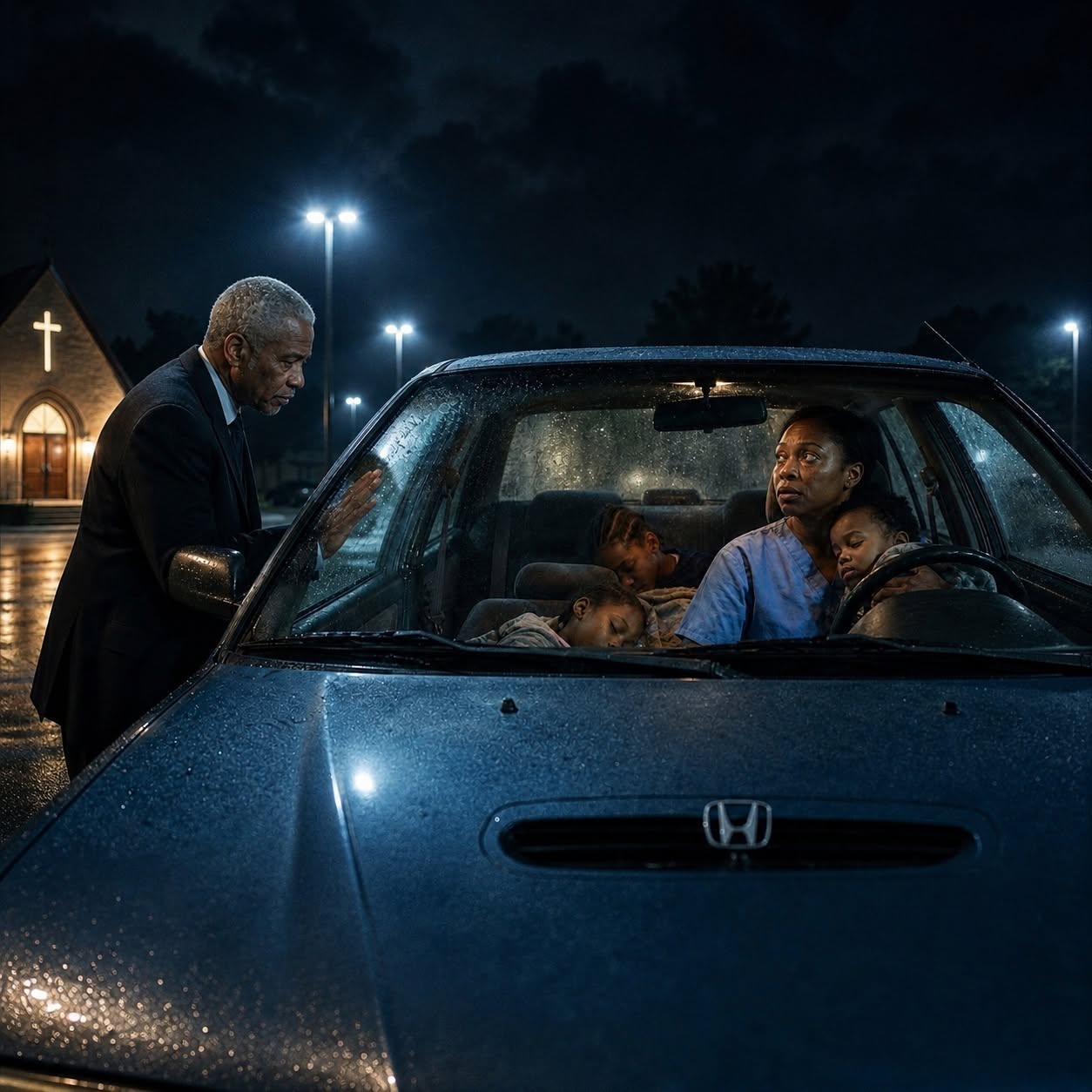
“You don’t,” Solomon said. “I’m a stranger. You have every reason not to trust me. All I can tell you is my mother slept in a car with me 40 years ago, and nobody knocked on her window. I’m knocking on yours.”
Tamara took the card with trembling fingers.
“My kids come first,” she said.
“I know,” Solomon replied. “That’s exactly why I’m here.”
The hotel room was ordinary, but to Tamara’s children it looked like a palace.
Nala touched the bar of soap in the bathroom like it was treasure.
Isaiah crawled onto the bed and fell asleep in less than 1 minute.
Zion stood in the doorway for a long time, staring at the sheets, the lamp, the heater, the locked door. Then he sat on the floor, pulled his knees to his chest, and cried silently.
Tamara sat beside him and held him.
She did not tell him not to cry. He had been brave for too long.
The next morning, Solomon came with coffee, muffins, and a chocolate cookie big enough to make Nala gasp.
He sat with Tamara at the small hotel table and asked, “Tell me what happened.”
So she did.
She told him about the eviction notice, the shelters, the library, the $8 decision, the car dying, Zion pushing beside her in the dark.
When she finished, she looked down at her coffee.
“The worst part isn’t being homeless,” she said. “It’s knowing I did everything right. I worked. I paid what I could. I took care of my kids. I didn’t make enough money, and somehow that was enough to lose everything.”
Solomon did not insult her pain with easy comfort.
He only said, “My mother said almost the same thing.”
Then he offered her 90 days.
Not charity, he said. A foundation.
Next »
An apartment in one of his company’s affordable housing units. Childcare through a partner program. Help enrolling in an accelerated LPN program so she could move from $14.50 an hour to a real nursing wage with benefits.
“I’m not giving you a new life,” Solomon said. “I’m giving you 90 days to build one.”
Tamara cried then. Not because she felt weak, but because for the first time in a week, she was somewhere safe enough to feel anything.
The apartment was small. Two bedrooms. Laminate floors. Plain cabinets. A refrigerator that hummed. A stove that worked. Heat. A front door with a lock.
Nala ran from room to room saying, “This is ours?”
“All of it,” Tamara said.
Zion stood at the doorway of the smaller bedroom.
“This is mine?”
“Yours.”
He stepped inside, touched the wall with his palm, and closed the door gently.
Tamara heard him crying on the other side. She almost opened it, then stopped herself.
For the first time, her son had a room where he could fall apart without anyone watching.
The next morning, Tamara enrolled in school.
She worked at Riverside from 7 to 3. She studied in the evenings. She helped Nala with homework, bathed Isaiah, packed lunches, and memorized medication dosages at the kitchen table while cold coffee sat beside her textbooks.
CJ drove the children to school and daycare.
Solomon visited once a month, never too much, never in a way that made Tamara feel owned by his kindness.
One day, Nala gave him a drawing: her mother in blue scrubs, Zion, herself, Isaiah, and Solomon standing slightly apart but still inside the picture.
At the top, she had written, My family and Mr. Solomon.
Solomon folded the paper carefully and put it in his coat pocket.
Later, he sat in the Escalade for 10 minutes without speaking, because that drawing gave him something money never had: a place in someone’s story.
Halfway through the LPN program, Tamara found a woman sitting on the hallway floor one level below her apartment. Her name was Keturah. She had 2 children, a tired face, and the same guarded eyes Tamara had carried through that fogged window weeks before.
“We’re fine,” Keturah said.
Tamara almost smiled.
“I didn’t ask if you’re fine,” she said gently. “I asked your name.”
That night, Tamara cooked extra rice and beans. She brought food downstairs. Then she helped Keturah fill out housing applications, called programs, shared childcare contacts, and sat beside her through paperwork that seemed designed to exhaust desperate people.
When Solomon found out, he asked, “You barely have enough for yourself. Why are you giving to someone else?”
Tamara looked at him like the answer was obvious.
“Because 7 weeks ago, I was her,” she said. “And somebody knocked on my window. I can’t walk past hers and pretend I don’t hear the same sound.”
Those words followed Solomon all the way back to Atlanta.
Two days later, for the first time in 3 years, he walked into the shelter named after his daughter.
The lobby smelled like floor cleaner, cooked food, and tired hope. On the wall was Amara’s photograph: scrubs, stethoscope, bright smile.
Below it, a plaque read: In loving memory of Amara Adami, who held hands and hearts in equal measure.